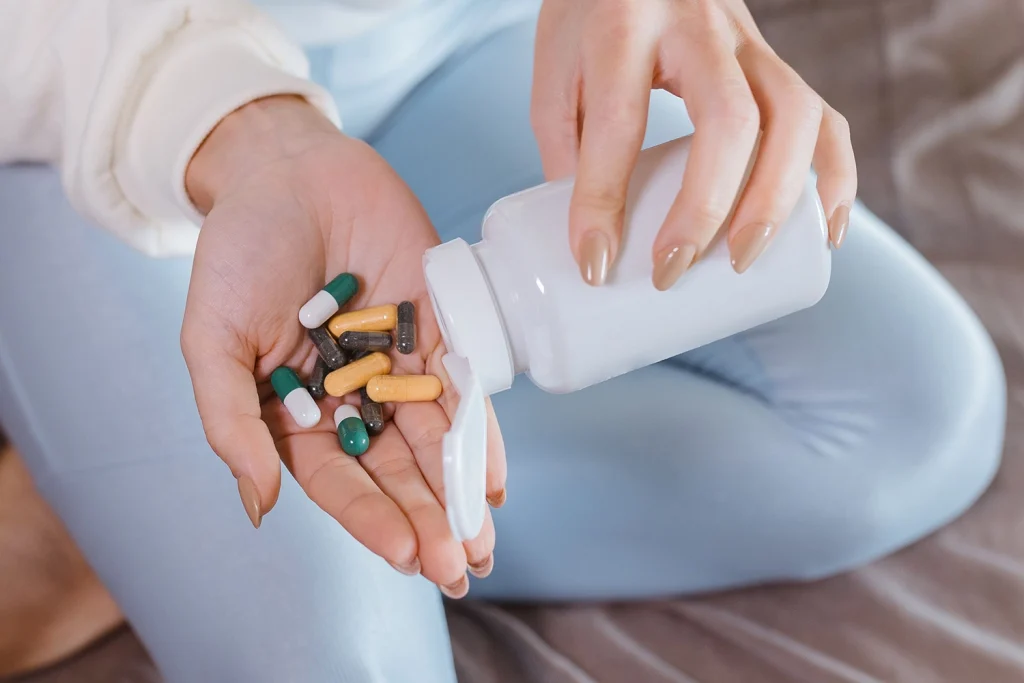
Do Antioxidant Supplements Undercut Your Workouts?
Plenty of people who train hard take vitamin C and E on the theory that exercise creates oxidative stress and antioxidants clean it up. This article asks whether that holds. Do high-dose vitamins C and E help or blunt what training is supposed to do for your body? And if antioxidant pills aren’t the answer, where do polyphenols fit in?
Two controlled trials address the first question directly. In 2009, Ristow and colleagues tested whether vitamin C and E change the metabolic benefits of four weeks of exercise, including insulin sensitivity and the body’s own defense systems (Ristow et al., PNAS, 2009). In 2014, Paulsen and colleagues asked whether the same vitamins change how muscle adapts to 11 weeks of endurance training, and whether that shows up in running performance (Paulsen et al., Journal of Physiology, 2014). We looked at these studies because supplements are easy to buy and easy to assume are harmless, and the evidence doesn’t back that up. The second question matters because polyphenols often get lumped in with antioxidants, but they work through your gut microbes, and that changes how you should think about them.
What the trials found
In the German study, 40 healthy young men (25-27 years old), some previously untrained and some already fit, did four weeks of exercise training. Half took 1,000 mg of vitamin C and 400 IU of vitamin E a day. The men who trained without the vitamins became more insulin sensitive and built up their bodies’ own defense systems. The men taking the vitamins got much less of either (Ristow et al., PNAS, 2009).
The 2014 study was larger. Fifty-four young men and women trained for 11 weeks, mostly running, three to four sessions a week, split between hard intervals and steady runs. Half took 1,000 mg of vitamin C and 235 mg of vitamin E daily, and half took a placebo. The supplement group showed weaker increases in markers of mitochondrial growth, the cellular machinery behind endurance (Paulsen et al., Journal of Physiology, 2014). Their VO2max and running performance didn’t differ from the placebo group over that period. So the vitamins didn’t make anyone slower in 11 weeks. However, they did dampen one of the main adaptations you train for, and over a season or a career, that matters.
Why this happens
The reactive oxygen species your muscles produce during a hard session do cause some damage. They also act as a signal telling the muscle to adapt: build more mitochondria, strengthen your own antioxidant enzymes, handle the next session better. In both trials, genes that drive those responses, including PGC-1α, rose in the placebo groups and stayed flat in the vitamin groups. Unexpectedly, high-dose antioxidants seem to silence the signal along with the damage.
Where polyphenols fit
Polyphenols, the compounds in berries, cocoa, tea and olive oil, often get lumped in with antioxidants. Even though they act as antioxidants in the test tube, this isn’t how they work in your body. Most polyphenols can’t be absorbed in the small intestine in their original form. They travel to your colon, where gut microbes break them down into smaller compounds that your body absorbs and uses.
Urolithin A shows how this plays out. Pomegranates, walnuts and raspberries contain polyphenols called ellagitannins. Certain gut bacteria turn them into urolithin A, which researchers have studied for its beneficial effects on mitochondria in muscle. In a four-month trial in middle-aged adults, urolithin A improved leg strength (Singh et al., Cell Reports Medicine, 2022). In older adults, it improved muscle endurance (Liu et al., JAMA Network Open, 2022). Both trials used supplements in non-athletes, so this isn’t a performance claim. But it shows the path: food, then microbes, then muscle.
There’s a catch. Only around 40% of people have gut bacteria that can make meaningful amounts of urolithin A from these compounds. In other words, two athletes can eat the same pomegranate and get different results. Your microbes decide a lot of what your food does for you.
What to do with this
- Rethink high-dose vitamin C and E during training blocks. If you take them, ask a sports dietitian or your doctor whether you need them.
- Get polyphenols from food: berries, cocoa, green tea, olive oil, pomegranate, walnuts, beans, herbs and spices.
- Feed the microbes that do the converting. Plant variety and fiber keep that community diverse.
- Play the long game. Polyphenols work through your microbiome over weeks and months, not in the window after a workout.
Berries, cocoa, green tea and olive oil are the place to start. If you want a more consistent daily dose of polyphenols, Synaptic Bloom is how we do it at Mayer Nutrition.
Learn more about it here.
References
- Ristow M, Zarse K, Oberbach A, Klöting N, Birringer M, Kiehntopf M, Stumvoll M, Kahn CR, Blüher M. Antioxidants prevent health-promoting effects of physical exercise in humans. Proc Natl Acad Sci U S A. 2009;106(21):8665-8670. doi:10.1073/pnas.0903485106
- Paulsen G, Cumming KT, Holden G, Hallén J, Rønnestad BR, Sveen O, Skaug A, Paur I, Bastani NE, Østgaard HN, Buer C, Midttun M, Freuchen F, Wiig H, Ulseth ET, Garthe I, Blomhoff R, Benestad HB, Raastad T. Vitamin C and E supplementation hampers cellular adaptation to endurance training in humans: a double-blind, randomised, controlled trial. J Physiol. 2014;592(8):1887-1901. doi:10.1113/jphysiol.2013.267419
- Singh A, D’Amico D, Andreux PA, Fouassier AM, Blanco-Bose W, Evans M, Aebischer P, Auwerx J, Rinsch C. Urolithin A improves muscle strength, exercise performance, and biomarkers of mitochondrial health in a randomized trial in middle-aged adults. Cell Rep Med. 2022;3(5):100633. doi:10.1016/j.xcrm.2022.100633
- Liu S, D’Amico D, Shankland E, Bhayana S, Garcia JM, Aebischer P, Rinsch C, Singh A, Marcinek DJ. Effect of urolithin A supplementation on muscle endurance and mitochondrial health in older adults: a randomized clinical trial. JAMA Netw Open. 2022;5(1):e2144279. doi:10.1001/jamanetworkopen.2021.44279
Some content in this article may have used AI-assisted tools for research, grammar, or outlining. All articles are reviewed and approved by our human editorial team.

E. Dylan Mayer, MS holds a Master’s Degree in Nutrition from Columbia University. He is a graduate from the University of Colorado at Boulder, with a major in Neuroscience and minor in Business.
✓ This article was reviewed and approved by Emeran Mayer, MD