Episode 127
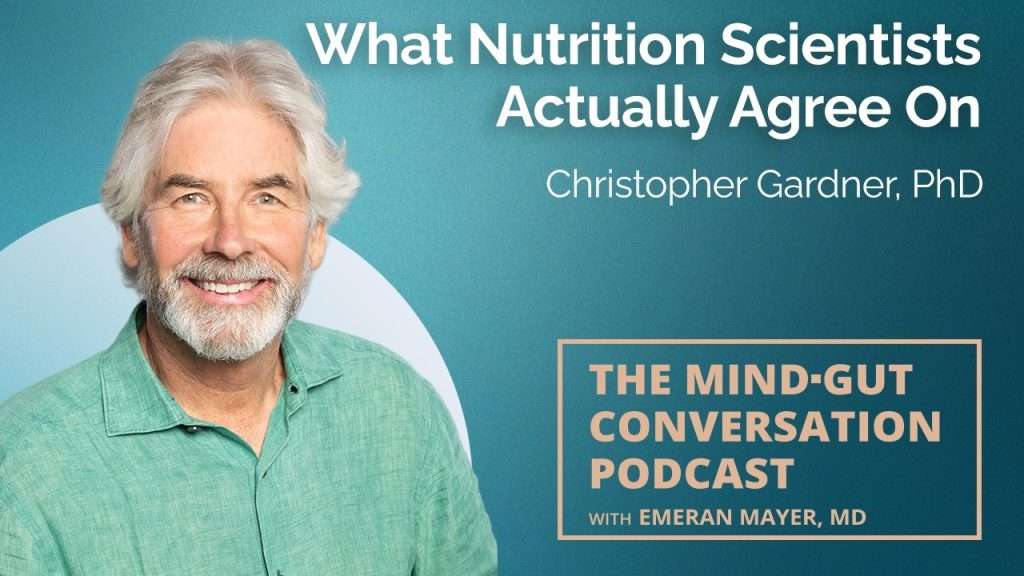
What Nutrition Scientists Actually Agree On with Christopher Gardner, PhD
Listen Now
dss
sss
In this episode of The Mind-Gut Conversation, Dr. Emeran Mayer speaks with Dr. Christopher Gardner, professor of medicine at Stanford University, about his new book, Food Sense, and his argument that nutrition has far more consensus than the headlines suggest.
Gardner has studied nutrition for more than 30 years. He served on the Dietary Guidelines Advisory Committee, has worked with the American Heart Association, and sits on the scientific advisory board of the Culinary Institute of America. His view is that no single diet works for everyone, but a small set of foundational habits holds up across most of them. Many food controversies lose their edge once you ask two questions: what is this food being eaten with, and what is it replacing?
The conversation moves through some of the most contested topics in nutrition. Mayer and Gardner discuss GLP-1 weight loss drugs and the open questions about long-term nutrition and sustainability, the Stanford studies Gardner ran with recreational athletes eating vegan and omnivore diets, and what plant foods offer in protein and fiber. Fiber comes up repeatedly because of what it does for the microbiome and the brain-gut axis. They also cover dairy, fermented foods, why inflammation is difficult to measure clinically, and what the evidence says about seed oils.
Gardner also gives his own account of serving on the Dietary Guidelines Advisory Committee, and of how politics and industry influence what ends up on American plates.
Key topics covered
- The main message of Food Sense and the “with what” and “instead of what” approach to nutrition questions
- GLP-1 drugs: what they do, and what we still don’t know about long-term safety
- Plant protein versus animal protein, and why Gardner says the real shortage is fiber
- Dairy, lactose intolerance, and the case for yogurt
- Fermented foods, inflammatory markers, and the seed oil debate
- The politics behind the dietary guidelines
For anyone who has felt anxious in a grocery aisle or at a restaurant table, this conversation offers a calmer way to think about food.
Chapters
0:00 – Introduction
4:00 – The Main Message of Food Sense
9:42 – GLP-1 Drugs and the Food Environment
21:13 – Plant Protein vs. Animal Protein
35:12 – Food Politics, Dietary Guidelines, and Dairy
44:37 – Fermented Foods, Inflammation, and Seed Oils
54:27 – Closing: What Gardner Eats
Frequently asked questions
What is the main message of Food Sense?
Gardner argues that nutrition changes slowly and that there is more agreement than the headlines suggest. No one diet works for everyone, but there are foods most people should eat more often and foods they should eat less often. He suggests asking “with what?” and “instead of what?” about any food, because context settles many of the arguments.
What does Gardner think about GLP-1 weight loss drugs?
He calls the weight loss they produce impressive, especially for people with much more than 5 to 10 percent of their body weight to lose. His concerns are nutritional deficiencies that may not show up right away, the fact that weight typically returns when the drugs stop unless habits have changed, and the lack of long-term safety and sustainability data.
Do you need animal protein to stay strong and active?
Gardner describes two small, short Stanford studies in which recreational athletes ate vegan and omnivore diets for four weeks. Their running and weight lifting did not change. He notes these were not elite athletes and not large funded trials.
Do plant foods contain all the amino acids?
According to Gardner, yes: all plant foods contain all 20 amino acids. Grains run lower in lysine and beans run lower in methionine, but neither is missing. Over a day of varied eating, the proportions even out, and the foods do not need to be combined at the same meal.
Can the body store extra protein for later?
Gardner says no. Fat can be stored without limit and carbohydrate in small amounts, but there is no storage depot for protein, and the excess is converted to carbohydrate.
Is dairy necessary?
Gardner cites the figure that about 75 percent of people worldwide are lactose intolerant and points out that no dairy deficiency disease exists. The nutrients in dairy are available from other foods. Yogurt is his one exception, as a fermented food.
What did the Stanford fermented foods study find?
In the study Gardner describes, 36 people followed either a high-fermented-food or a high-fiber diet. In the fermented group, 20 of the 90 inflammatory markers measured went down. Fermented foods included kimchi, sauerkraut, yogurt, kombucha, and kefir. A follow-up study with 135 pregnant women is nearly finished.
Do seed oils cause inflammation?
Gardner says he has seen no body of research showing that seed oils raise inflammatory markers, and that omega-6 fats replacing saturated fats are linked to lower rates of diabetes and heart disease. He also notes that inflammation still lacks a standard clinical measure.