PODCAST DIGESTS
Digging deeper into some of our most notable podcasts to explore all of the information in-depth.
LET'S TAKE A DEEP DIVE INTO PODCAST #106
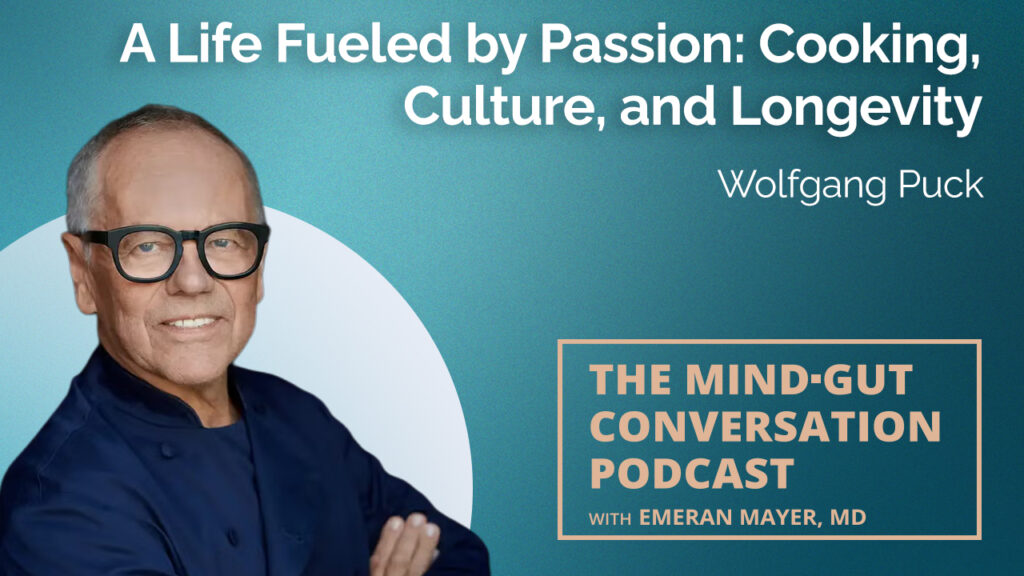
A Life Fueled by Passion: Cooking, Culture, and Longevity
SUMMARY
The Ingredients for a Good Life: What Wolfgang Puck Can Teach Us About Food, Resilience, and Longevity
When most people hear the name Wolfgang Puck, they probably think of Spago, celebrity-filled dining rooms, California cuisine, or perhaps his famous smoked salmon pizza.
But behind the restaurants and international success is a much more interesting story. It is one about resilience, curiosity, simplicity, and a lifelong relationship with food that began long before Wolfgang became one of the world’s most recognizable chefs.
What struck me most about Wolfgang’s story was not simply what he accomplished. It was the energy and curiosity he has maintained throughout his life, despite an extraordinarily difficult beginning.
And perhaps there is something in that story for all of us.
Finding Safety in the Kitchen
Wolfgang grew up in southern Austria in a difficult home environment. His relationship with his stepfather was particularly painful, and he describes his mother and grandmother as the loving counterbalance during those early years.
The kitchen became a refuge.
There, he helped make palatschinken filled with homemade apricot or raspberry jam, chocolate Kugelhupf for Sunday mornings, and meals prepared with ingredients grown or raised close to home.
At just 14 years old, Wolfgang left home to begin a cooking apprenticeship.
The experience was hardly glamorous. After a chef told him he was not good enough and should return home, Wolfgang reached an extraordinarily dark point. Yet the next morning, he went back to work.
That persistence would become one of the defining patterns of his life.
For me, his story immediately raised the subject of resilience. Early adversity can leave lasting imprints on the brain and body, and feelings of inadequacy can follow people long after the circumstances that created them have disappeared.
Wolfgang acknowledged that insecurity remained with him even as he became successful.
What eventually began to change it was finding the right environment and, importantly, the right mentor.
The Mentor Who Changed Everything
During his years cooking in France, Wolfgang worked at the renowned restaurant Baumanière in Provence, where he met chef and owner Raymond Thuilier.
It was there that Wolfgang saw a philosophy of food and hospitality that would shape the rest of his career.
The vegetables and fruits came directly from the restaurant’s gardens. Seafood came from the nearby Mediterranean. Ingredients were treated with respect rather than buried beneath unnecessary complexity.
The principle was remarkably simple:
Start with the best ingredients. Keep the preparation simple. Don’t interfere too much with what already tastes good.
But Wolfgang learned something else there as well.
Hospitality was not simply about serving food. It was about making people feel welcome.
That combination of exceptional ingredients, simplicity, generosity, and genuine pleasure became his blueprint.
Years later, when he created restaurants of his own, those lessons remained.
Creating a Cuisine That Belonged to California
After working in some of Europe’s most prestigious kitchens, Wolfgang came to the United States and eventually settled in Los Angeles.
Rather than simply reproducing classical French cuisine, he became fascinated by the city around him.
Los Angeles was not culturally uniform. It was filled with influences from Japan, China, Korea, Mexico, and many other parts of the world. Wolfgang explored those communities, ate their food, learned their techniques, and began incorporating what inspired him into his own cooking.
At the same time, he sought out the freshest local ingredients he could find.
When Spago opened in 1982, its open kitchen, wood-burning oven, locally sourced produce, and multicultural influences were highly unusual. Wolfgang described the food simply as California cuisine.
The concept seems familiar today, but at the time it represented a significant departure from the rigid categories that defined many fine-dining restaurants.
And underneath all of the creativity was still the lesson he had learned in Provence: begin with excellent ingredients and allow them to remain recognizable.
That philosophy eventually produced dishes that became classics, sometimes almost by accident.
His famous smoked salmon pizza, for example, emerged after the restaurant ran out of bread one evening. Wolfgang baked pizza dough instead, added dill cream, smoked salmon, caviar, and chives, and discovered a combination that guests still request more than four decades later.
Innovation does not always require making something more complicated.
Sometimes it simply requires curiosity.
Healthy Food Does Not Have to Feel Like "Health Food"
When the subject turned to health, Wolfgang was careful to point out that he is a chef, not a physician or nutritionist.
Still, many of his instincts about food are remarkably straightforward.
He questioned enormous restaurant portions. He emphasized vegetables, salads, fresh ingredients, and cooking at home. Fried foods could certainly have a place, but they did not need to become the foundation of one’s diet.
Most importantly, he returned again and again to ingredient quality.
His philosophy could almost be reduced to one rule: buy excellent ingredients and don’t ruin them.
There is something refreshingly uncomplicated about that.
We have developed an enormous industry around telling people how to eat. Foods are categorized, quantified, fortified, processed, reformulated, and marketed according to constantly changing ideas about health.
Meanwhile, some of the most satisfying foods require very little manipulation.
Fresh carrots roasted with olive oil. Vegetables cooked properly rather than boiled until they lose their texture. Tomatoes that actually taste like tomatoes. Fruit picked when it is ripe.
Wolfgang remembered taking his children to farmers markets and allowing them to taste green beans, strawberries, cherries, corn, and carrots directly from the growers. At home, vegetables might receive little more than olive oil and salt.
His children learned to enjoy them not because they had been told they were “healthy,” but because they tasted good.
Teaching the Brain What Good Food Tastes Like
This point is particularly interesting from the perspective of the brain-gut connection.
Our food preferences begin developing early in life. Repeated exposure helps shape what the brain recognizes as familiar, desirable, and rewarding.
When children primarily encounter foods dominated by intense sweetness, saltiness, and fried textures, those experiences can become part of their expected flavor landscape.
But the opposite is also possible.
Children can become familiar with the sweetness of a fresh carrot, the acidity of a ripe tomato, the texture of properly cooked broccoli, or the enormous variety of flavors found in minimally processed foods.
Wolfgang did not describe this as a formal health strategy. He simply exposed his children to good ingredients and good cooking.
That distinction may be more important than it first appears.
Healthy eating does not have to begin with restriction. It can begin with developing an appreciation for real food.
Cooking as Participation
Another theme emerged repeatedly: cooking keeps us connected to what we eat.
Modern food systems have made it remarkably easy to become passive consumers. A meal can arrive at the door without our knowing where its ingredients came from, how they were prepared, or even exactly what is in them.
Wolfgang’s approach is almost the opposite.
Go to the market when you can. Look at the vegetables. Taste the fruit. Learn where ingredients come from. Cook something yourself.
It does not have to be elaborate.
Roasting carrots with a little olive oil can transform them. Fresh broccoli or asparagus can be prepared quickly. A simple meal made from good ingredients may require far less culinary skill than people imagine.
The important shift is from passive consumption to participation.
And participation naturally encourages curiosity.
Perhaps Curiosity Is an Ingredient Too
Toward the end of Wolfgang’s story, food almost became secondary.
Despite decades of success, he remains intensely interested in what he has not yet learned.
He described traveling to Japan to understand how cattle are raised, visiting small producers, learning how traditional spirits are made, and continuing to explore unfamiliar cultures and cuisines. There are still countries he wants to visit, foods he wants to taste, and things he wants to understand.
His attitude can be summarized simply:
See more. Learn more. Stay curious.
For someone who spends much of his work thinking and writing about brain health and longevity, I find this particularly compelling.
We often discuss longevity through the familiar pillars of nutrition, exercise, sleep, and metabolic health. All of these are important.
But there is another dimension that receives considerably less attention: remaining interested in life.
Having something that excites you.
Continuing to learn.
Maintaining relationships.
Creating.
Traveling.
Teaching.
Discovering something you did not know yesterday.
Wolfgang’s enthusiasm has not diminished with age. If anything, his curiosity seems to provide fuel for what comes next.
The Ingredients for a Good Life
There is an appealing symmetry to Wolfgang Puck’s story.
The kitchen that offered refuge to a young boy in Austria eventually became the center of an extraordinary life.
The vegetables from his mother’s garden became a lifelong appreciation for fresh ingredients.
The mentor who showed him the value of simplicity and hospitality gave him principles he would later carry into restaurants around the world.
The insecurity of his early years did not disappear overnight, but it coexisted with persistence, creativity, and an unwillingness to stop learning.
And after decades of achievement, his philosophy remains surprisingly uncomplicated.
Choose good ingredients.
Prepare them well.
Stay curious.
Love what you do.
Keep learning.
Perhaps we should think about longevity in much the same way we think about a great meal. There is no single ingredient responsible for the final result.
Food matters. Movement matters. Sleep matters. Relationships matter.
But passion matters too.
A long life is valuable not simply because of the number of years it contains, but because we remain engaged enough to keep living those years with curiosity.
Wolfgang said it best in his own wonderfully simple way:
“Life is to live.”
FAQ
What can Wolfgang Puck's story teach us about resilience?
Wolfgang’s journey reminds us that difficult beginnings do not necessarily determine the course of our lives. Despite experiencing adversity and insecurity early on, he found purpose through cooking, supportive mentors, and a willingness to keep learning. His story illustrates how meaningful work, positive relationships, and persistence can help shape resilience over time.
Why does the quality of our ingredients matter so much?
Fresh, minimally processed ingredients often provide a combination of nutrients, flavors, and textures that can be lost or altered through extensive processing. Wolfgang’s philosophy emphasizes choosing quality ingredients and preparing them simply, allowing their natural flavors to shine. It’s a reminder that eating well doesn’t always require complicated recipes or strict dietary rules.
How do childhood food experiences influence our eating habits later in life?
Our food preferences begin developing early, shaped partly by repeated exposure and the flavors we learn to recognize and enjoy. Introducing children to a variety of fresh vegetables, fruits, and home-cooked meals can help them develop an appreciation for these foods. Rather than emphasizing what children should or shouldn’t eat, making nutritious foods enjoyable may help establish healthier eating patterns over time.
Can cooking at home actually improve our relationship with food?
Cooking encourages us to become more active participants in what we eat. Choosing ingredients, exploring flavors, and preparing meals can increase our awareness of food quality and how meals are made. Even simple home-cooked dishes can help us reconnect with food as something to enjoy and appreciate rather than simply consume.
What role does curiosity play in healthy aging?
Curiosity encourages us to continue learning, exploring, and engaging with the world around us. Research suggests that cognitive stimulation, meaningful activities, and social engagement may contribute to brain health as we age. Wolfgang’s lifelong enthusiasm for discovering new foods, cultures, and experiences offers a wonderful example of remaining mentally engaged throughout life.
What is the most important lesson from Wolfgang Puck's approach to food and longevity?
Perhaps the greatest lesson is that a healthy, fulfilling life isn’t built around one perfect ingredient or habit. Nutrition, movement, sleep, relationships, and meaningful experiences all contribute to our well-being. Wolfgang’s story reminds us that enjoying what we do, staying curious, and appreciating life’s simple pleasures may be just as important to the quality of our years as the number of years we live.