PODCAST DIGESTS
Digging deeper into some of our most notable podcasts to explore all of the information in-depth.
LET'S TAKE A DEEP DIVE INTO PODCAST #77
Intuition, the Brain, and the Body: Rethinking How We Make Decisions
SUMMARY
In modern medicine and science, we are trained to value data, logic, and analytical thinking. Yet, in both clinical practice and everyday life, some of our most important decisions arise from something far less tangible: a “gut feeling.”
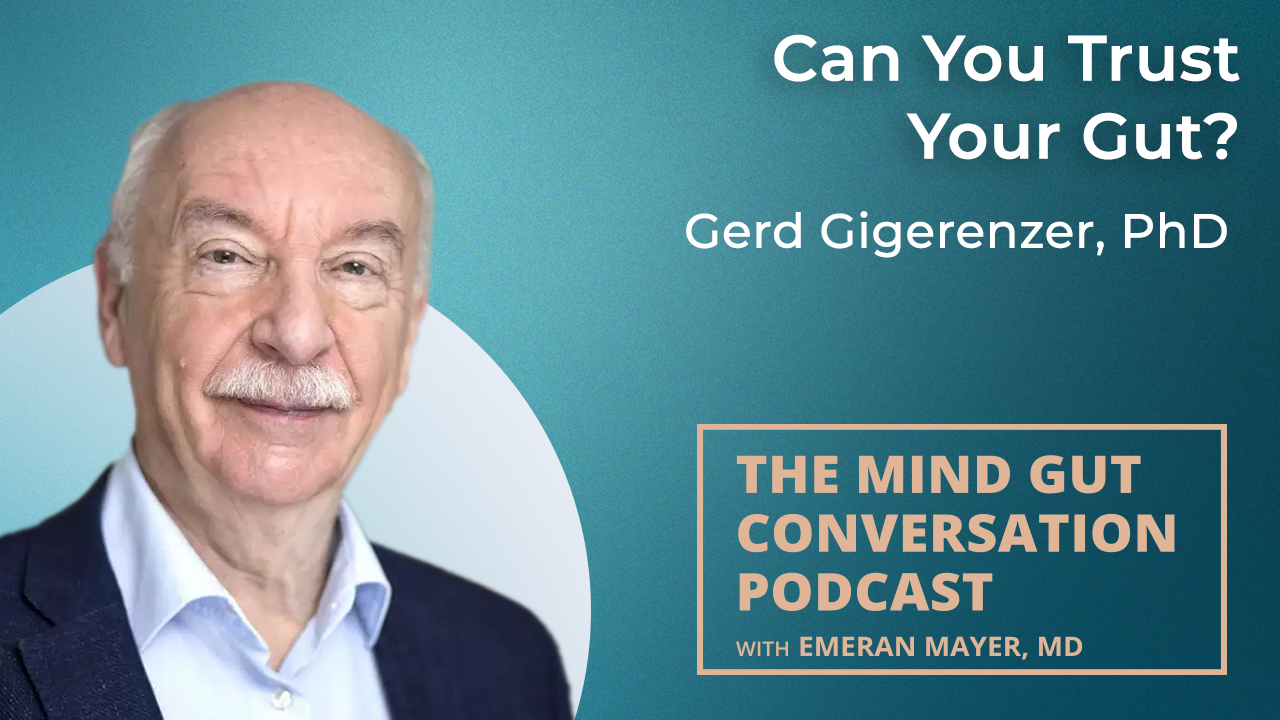
In this conversation with decision-making expert Dr. Gerd Gigerenzer, we explore the science behind intuition, how the brain navigates uncertainty, and why simple decision strategies often outperform complex analysis. We also examine how intuition emerges from experience, how it complements rational thinking, and why it may play a critical role in both health and human behavior.
Understanding intuition not as a vague or mystical phenomenon, but as a form of embodied intelligence, may reshape how we think about decision-making in medicine, science, and beyond.
What Is a Gut Feeling Really?
We use the phrase “trust your gut” all the time.
But what does it actually mean?
According to Dr. Gigerenzer, intuition is not mystical, emotional noise, or some vague “sixth sense.” It’s something much more grounded.
He defines intuition as:
- a feeling built on years of experience
- that appears quickly in your awareness
- and is difficult to explain in words
In other words, your brain has learned patterns over time… and sometimes it delivers an answer before your conscious mind can catch up.
A seasoned physician sensing something is “off” with a patient.
An athlete making a split-second decision mid-performance.
A leader knowing which direction to take when data is unclear.
That’s intuition in action.
Intuition Is Not the Opposite of Logic
One of the biggest misconceptions is that intuition and rational thinking are enemies.
They’re not.
In fact, they work together.
A doctor may feel that something is wrong (intuition)… and then run tests (analysis).
A business leader may sense a decision is risky… and then gather data to confirm or challenge it.
Intuition often provides the signal.
Reasoning provides the verification.
Separating the two, or ranking one above the other, creates a false divide that limits better decision-making.
Why Experience Is the Foundation of Intuition
You don’t get intuition without exposure.
It’s not something you’re simply born with (that would be instinct). It’s something you build.
- musicians develop it through years of practice
- athletes through repetition under pressure
- clinicians through thousands of patient interactions
Over time, the brain stores patterns… and eventually, decisions become automatic.
Interestingly, people who rely on intuition often can’t explain how they know something.
They just do.
That doesn’t make it unreliable. It means the processing is happening below conscious awareness.
The “Less Is More” Principle in Decision Making
This is where things get really interesting.
We tend to believe that more data leads to better decisions.
But under uncertainty, that’s often false.
Dr. Gigerenzer’s research shows that in unpredictable environments:
- simple rules
- fewer variables
- and focused cues
can outperform complex models.
Why?
Because complex systems tend to “overfit” the past. They assume the future will behave the same way.
But in real life, it doesn’t.
Unexpected events, sudden changes, and “black swans” break those models.
So instead of trying to account for everything, effective decision-making often comes down to identifying what matters most… and ignoring the rest.
Living in a World of Uncertainty (Not Risk)
Here’s a key distinction most people miss:
- Risk = you know all possible outcomes and probabilities
- Uncertainty = you don’t
Most real-world decisions fall into uncertainty.
Markets shift.
People behave unpredictably.
New events emerge that no model could have anticipated.
This is where intuition becomes critical.
In stable environments, calculation works well.
In unstable environments, experience-based judgment wins.
Why AI Still Struggles With Real Life
AI is powerful. But it has limits.
Modern AI systems are excellent at pattern recognition in stable, well-defined environments.
Think:
- chess
- language prediction
- controlled industrial systems
But when surprises happen, AI often fails.
A famous example is Google Flu Trends, which tried to predict flu outbreaks using search data. It struggled because real-world conditions changed in ways the model couldn’t anticipate.
In contrast, a simple heuristic (like using the most recent data point) performed better.
That’s the “less is more” principle again.
AI thrives on patterns.
Humans adapt to change.
Heuristics: The Brain’s Shortcut System
A heuristic is a simple rule of thumb.
And despite how that sounds, it’s not “lazy thinking.” It’s efficient thinking.
Examples:
- follow the most recent trend
- focus on one key variable
- imitate a trusted source
These shortcuts allow us to act quickly without processing massive amounts of data.
Even animals use heuristics.
For example, a baseball outfielder doesn’t calculate the trajectory of a ball. Instead, they adjust their movement to keep the angle of their gaze constant. This simple rule leads them exactly where the ball will land.
Elegant. Efficient. Effective.
The Problem: We Don’t Trust Intuition Publicly
Here’s one of the most fascinating insights from the conversation:
Many leaders DO rely on intuition.
But they don’t admit it.
In fact, in some corporate environments:
- up to 50% of major decisions are ultimately made based on gut feeling
- but then justified afterward with data or consulting reports
Why?
Because intuition requires ownership.
You can’t hide behind a spreadsheet if you were “just following your gut.”
So instead, organizations spend time and money rationalizing decisions that were already made intuitively.
The Cultural Bias Against Intuition
Modern education trains us to:
- be logical
- be analytical
- justify everything
And while those skills are valuable, they’ve come at a cost.
We’ve created a system that:
- distrusts intuitive insight
- overvalues complexity
- and mistakes confidence for accuracy
Even worse, intuition is often framed as inferior or emotional, rather than intelligent and experience-based.
But as Einstein put it:
“The intuitive mind is a sacred gift, and the rational mind is a faithful servant.”
We’ve simply flipped the priority.
A Shift Toward Integrated Thinking
There’s growing recognition that the future of decision-making isn’t about choosing between intuition and logic.
It’s about integrating them.
We’re seeing this shift in:
- systems thinking
- biology and interconnected models
- leadership styles
- even organizational design
Instead of linear, rigid thinking, there’s movement toward:
- adaptability
- pattern recognition
- and context-aware judgment
Which is exactly where intuition thrives.
FAQ
What is the difference between intuition and instinct?
Instinct is inborn and genetically programmed.
Intuition is learned through experience over time.
Instinct helps you react.
Intuition helps you decide.
Can intuition be trusted?
Yes, but only in areas where you have experience.
A seasoned professional’s intuition is often highly reliable.
A beginner’s intuition is not.
Why can’t people explain their intuition?
Because it operates below conscious awareness.
Your brain recognizes patterns faster than your conscious mind can articulate them.
Is more data always better for decision-making?
No.
In uncertain environments, too much data can actually reduce accuracy by overcomplicating the decision.
Simple models often outperform complex ones.
How does intuition relate to the brain?
Intuition likely involves large networks of unconscious processing.
Rather than being located in one place, it reflects how the brain integrates experience, memory, and pattern recognition.
Why do companies hide intuitive decisions?
Because intuition requires accountability.
It’s easier to justify decisions with data, even if the decision was made instinctively.
Can AI replicate intuition?
Not fully.
AI works best in stable, predictable environments.
Human intuition excels in uncertain, changing conditions.
How can I strengthen my intuition?
- Gain experience in a specific area
- Pay attention to patterns over time
- Reflect on past decisions
- Balance intuition with thoughtful analysis